Smart Laboratory (SmartLab)
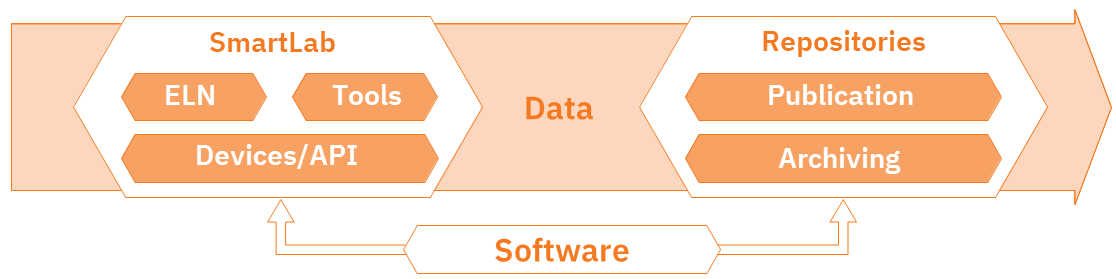
SmartLab – a holistic, FAIR‑centric approach to research data management in chemistry
A SmartLab integrates every step of a chemist’s workflow — from planning to archiving — into a seamless digital ecosystem. Unlike a traditional Laboratory Management System (LIMS), the primary goal of a SmartLab is to realise the FAIR data principles (Findable, Accessible, Interoperable, Re‑usable).
- Planning & documentation – The researcher records the experimental design in an electronic lab notebook (ELN).
- Data acquisition – Instruments (e.g., spectrometers) push raw data directly into the ELN via an Application Programming Interface (API).
- Automatic metadata & format conversion – The ELN assigns the appropriate metadata and converts proprietary data formats into open, standards‑compliant formats.
- Structured, machine‑readable records – Both the (meta)data and the experimental description are organised in a way that is readable by humans and machines, e.g., using machine‑readable chemical structures.
- Publishing & archiving – When the researcher decides to publish or archive the work, the ELN already supplies a FAIR‑ready package that can be ingested by a repository or archive with minimal additional effort.
In short, a SmartLab turns the entire research data lifecycle into a coherent, automated process, freeing scientists to focus on discovery rather than data wrangling.
In this section, key components of the smart lab will be introduced to you.
Get started:
![[object Object]](/knowledge_base/img/nfdi4chem_SmartLab.svg)
Electronic Lab Notebooks